
Design Meta Serverless Platform: A System Design Interview
The Interview Scenario
Interviewer: "Design a serverless platform like AWS Lambda or Meta's internal XFaaS. Target: handle millions of function invocations per second."
Candidate: "Interesting! Let me understand the requirements first."
---
Phase 1: Requirements Clarification (5 minutes)
Candidate: "Key questions:
- **Function types** - Short HTTP handlers or long-running jobs?
- **Execution environment** - Containers, VMs, or language-specific runtimes?
- **Triggers** - HTTP, events, scheduled?
- **Scale target** - What's our invocations per second goal?
- **Multi-tenancy** - Shared infrastructure across customers?"
Interviewer: "Design for:
- Short functions (typically <30 seconds)
- Container-based isolation
- HTTP and event triggers
- Target: 10+ million invocations per second
- Multi-tenant with strict isolation
- Cold start under 500ms"
Candidate: "Got it. Additional requirements I'll assume:
- **Pay-per-use** - Bill only for actual execution time
- **Auto-scaling** - 0 to millions without user intervention
- **High availability** - 99.99% uptime
- **Security** - Complete isolation between tenants
Interviewer: "Yes, those are critical."
---
Phase 2: Back-of-Envelope Calculations (5 minutes)
Candidate: "Let's size this:
Invocation volume:
- Target: 10 million invocations/second
- Average duration: 200ms
- Concurrent executions: 10M × 0.2s = **2 million concurrent containers**
Worker capacity:
- Each worker node: 64 cores, 256GB RAM
- Functions average 256MB RAM, 0.5 vCPU
- Functions per worker: ~200 concurrent
- Workers needed: 2M / 200 = **10,000 worker nodes**
Scheduler throughput:
- 10M scheduling decisions per second
- Single scheduler bottleneck at ~100K/s
- Need: **100+ scheduler instances** (partitioned)
Cold start impact:
- 10% cold starts = 1M/second new containers
- Container start time: 200ms (optimized)
- Container creation rate: 1M/second = significant challenge"
Interviewer: "What's the hardest scaling challenge?"
Candidate: "Cold starts at scale. Creating 1 million containers per second is extremely hard. We need aggressive pre-warming strategies."
---
Phase 3: High-Level Architecture (10 minutes)
Candidate: "Here's the architecture:"
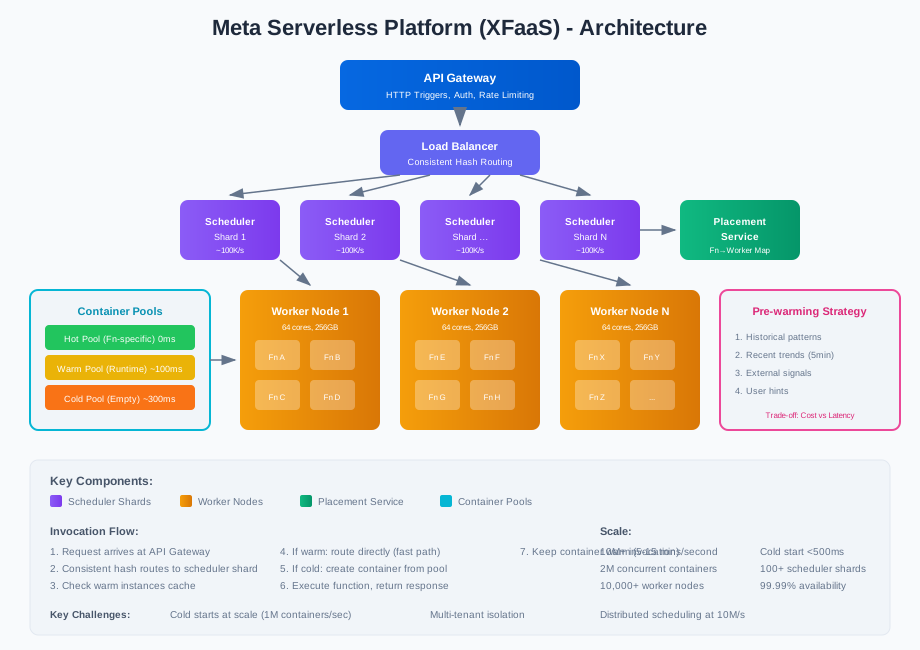
Interviewer: "Walk me through an invocation."
Candidate: "Step by step:
- **Request arrives** at API Gateway with function identifier
- **Auth & rate limiting** - Verify API key, check quotas
- **Scheduler receives request** - Consistent hashing routes to shard
- **Scheduler checks placement cache:**
- Warm instance available? → Route directly
- No warm instance? → Cold start path
- **Cold start (if needed):**
- Scheduler requests container from Worker pool
- Worker pulls function image (or uses cached)
- Container initialized with runtime
- Function code loaded
- **Execute function** - Worker runs function, streams response
- **Return result** - Response back through Gateway
- **Container kept warm** - Available for next invocation
Key optimization: Keep containers warm for 5-15 minutes after last invocation."
---
Phase 4: Deep Dive - Cold Start Optimization (10 minutes)
Interviewer: "Cold start is critical. How do you get it under 500ms?"
Candidate: "This is the hardest problem. Multiple strategies:
Strategy 1: Pre-warming
```
// Predictive model based on historical patterns
function predictCapacity(functionId, timeOfDay) {
// ML model predicting invocations per minute
// Pre-warm containers before expected traffic spike
}
// Keep pool of 'generic' warm containers
// Initialize with runtime, inject function code on demand
```
Strategy 2: Snapshot/Restore (Firecracker approach)
```
Traditional cold start:
- Create container (100ms)
- Start runtime (200ms)
- Load function code (50ms)
- Initialize dependencies (100-500ms)
Total: 450-850ms
Snapshot approach:
- Pre-create snapshot of initialized function
- On cold start: restore from snapshot (50ms)
- Resume execution
Total: ~50-100ms
```
AWS Firecracker does this with microVMs!
Strategy 3: Tiered container pools
```
Pool Hierarchy:
├── Hot Pool (function-specific warm containers)
│ └── Instant routing, 0ms overhead
├── Warm Pool (runtime-initialized, no function)
│ └── Just load function code, ~100ms
├── Cold Pool (empty containers)
│ └── Full initialization, ~300ms
└── Creation (new container)
└── Full cold start, ~500ms
```
Interviewer: "How do you decide how many to pre-warm?"
Candidate: "Prediction model with multiple signals:
- **Historical patterns** - Same time yesterday/last week
- **Recent trend** - Invocations in last 5 minutes
- **External signals** - Marketing campaigns, launches
- **User hints** - Provisioned concurrency setting
```
// Simple exponential smoothing with time-of-day seasonality
predicted = α × recent + (1-α) × historical_same_time
// Buffer = predicted × (1 + safety_margin)
// safety_margin = 0.2 for normal functions
// safety_margin = 0.5 for spiky functions
```
Cost trade-off: Pre-warming costs money (idle resources) but improves latency. Let users choose their trade-off with 'provisioned concurrency' setting."
---
Phase 5: Multi-tenancy & Isolation (8 minutes)
Interviewer: "How do you isolate tenants on shared infrastructure?"
Candidate: "Security isolation is non-negotiable:
Level 1: Container Isolation
```
Each function runs in:
- Separate container with own filesystem
- Resource limits (CPU, memory, network)
- Seccomp profiles limiting syscalls
- Read-only root filesystem
```
Level 2: Network Isolation
```
┌─────────────────────────────────────┐
│ Worker Node │
│ ┌─────────────────────────────┐ │
│ │ Virtual Network (per tenant)│ │
│ │ ┌─────┐ ┌─────┐ ┌─────┐ │ │
│ │ │Fn 1 │ │Fn 2 │ │Fn 3 │ │ │
│ │ └─────┘ └─────┘ └─────┘ │ │
│ └─────────────────────────────┘ │
│ ┌─────────────────────────────┐ │
│ │ Virtual Network (tenant B) │ │
│ │ ┌─────┐ ┌─────┐ │ │
│ │ │Fn A │ │Fn B │ │ │
│ │ └─────┘ └─────┘ │ │
│ └─────────────────────────────┘ │
└─────────────────────────────────────┘
```
Level 3: Noisy Neighbor Prevention
```
// Per-tenant resource quotas
tenant_limits:
cpu_cores: 1000
memory_gb: 2000
concurrent_executions: 10000
invocations_per_second: 100000
// Fair scheduling within worker
// If Tenant A is CPU-bound, shouldn't starve Tenant B
// Use Linux cgroups v2 for CPU bandwidth limiting
```
Interviewer: "What about data isolation?"
Candidate: "Multiple layers:
- **Memory** - Container isolation, no shared memory
- **Storage** - Ephemeral /tmp per invocation, cleared after
- **Environment** - Secrets injected at container start, encrypted at rest
- **Logs** - Routed to tenant-specific streams
- **Metrics** - Tagged with tenant ID, filtered at query time
For extra-sensitive workloads: dedicated worker pools (at premium price)."
---
Phase 6: Scheduler Design (5 minutes)
Interviewer: "How does scheduling work at 10M/second?"
Candidate: "Distributed scheduling is key:
Sharded Schedulers:
```
// Consistent hashing by function_id
scheduler_shard = hash(function_id) % num_schedulers
// Each scheduler handles ~100K invocations/second
// 100 schedulers = 10M/second capacity
```
Scheduler State:
```
// In-memory cache per scheduler
warm_instances: Map>
placement_cache: Map
function_metadata: Map
// Cached from central store, refreshed every second
```
Scheduling Decision Flow:
```
- Check warm_instances[function_id]
- If available: route to warm container (fast path)
- Check placement_cache[function_id]
- If exists: try preferred workers first
- Query Placement Service
- Find workers with capacity
- Prefer workers with cached function image
- Consider locality (same region as data)
- Create container on selected worker
- Update warm_instances cache
```
Load balancing across warm instances:
- Round-robin for equal distribution
- Weighted based on recent response times
- Power-of-two-choices: sample 2 random, pick least loaded"
---
Phase 7: Trade-offs (2 minutes)
Candidate: "Key decisions:
| Decision | Chose | Alternative | Trade-off |
|----------|-------|-------------|-----------|
| Isolation | Containers | VMs (Firecracker) | Speed vs security (VMs more secure but slower cold start) |
| Scheduling | Sharded | Centralized | Complexity vs scalability |
| Pre-warming | Predictive | Reactive | Cost vs latency |
| State | Stateless functions | Stateful | Simplicity vs capability |
What I'd add with more time:
- Durable execution (checkpointing for long functions)
- Step functions (workflow orchestration)
- Edge deployment (functions at CDN edge)"
---
Key Interview Takeaways
- **Cold start is THE challenge** - Spend time on optimization strategies
- **Pre-warming vs cost** - It's a trade-off; give users control
- **Sharded schedulers** - Single scheduler can't do 10M/s
- **Multi-tenancy** - Isolation is non-negotiable; layers of defense
- **Container pools** - Tiered pools balance latency and resource usage
📚Continue Reading
Part of the 🏗️ System Design Mastery collection

System Design Interview Tips: How to Ace Any Architecture Question
8 min read

Design YouTube: A System Design Interview Conversation
12 min read

Design Spotify: A System Design Interview Conversation
12 min read

Design Reddit: A System Design Interview Conversation
12 min read
Ready to Build Your Perfect Resume?
Let IdealResume help you create ATS-optimized, tailored resumes that get results.
Get Started Free